




You’ve done the research. You’ve watched the comparison videos, scrolled through the spec sheets, and now you’re standing at the same crossroads as thousands of other homeowners: infrared or traditional sauna? Here’s the problem with how most people approach this decision. They treat it like a tech debate, chasing temperature numbers and wavelength specs, when the real question is far more personal. Which sauna will you actually use every single week?
An infrared home sauna and a traditional steam sauna deliver meaningfully different experiences, from how the heat moves through your body to how the unit gets installed in your home. Neither is universally better. One is better for you, based on your wellness goals, your available space, your electrical setup, and the way you actually live.
This guide cuts through the noise by reframing the comparison around practical home-use criteria. You’ll find a clear breakdown of how each sauna heats the body, how their benefits align with specific health goals, what installation actually looks like, and what separates a sauna that transforms your routine from one that collects dust. Let’s start with the question that matters most.
The Real Question Isn’t Which Is Better
Most infrared vs. traditional sauna comparisons open with temperature ranges, wattage figures, and wavelength specs. That framing misses the decision that actually matters.
The more useful question is simpler: which sauna will you realistically use every week, given your home, your schedule, and what you’re trying to accomplish for your health?
This isn’t a minor reframe. Research on sauna health benefits consistently links frequency and consistency of use to meaningful wellness outcomes; the delivery mechanism is secondary. A dose-response relationship links regular sauna practice to meaningful wellness benefits, and lifestyle fit predicts results better than specs do.
The financial logic follows directly. A $10,000 traditional sauna that gets used twice a year delivers almost none of its potential value. An infrared home sauna at half the price, used four evenings a week as a recovery and wind-down ritual, delivers compounding wellness benefits and justifies every dollar. The gap between those two outcomes has nothing to do with heat type and everything to do with whether the sauna matched the buyer’s actual life.
This guide is built around that insight. Rather than ranking one sauna type over the other, the sections ahead evaluate both against the criteria that genuinely predict whether a home sauna gets used: how each type heats your body, what installation actually requires, which wellness goals each serves best, what ongoing maintenance looks like, and how each fits different household routines and spaces.
How Each Sauna Actually Heats You
The two sauna types work on fundamentally different physics, and that difference shapes everything about how a session actually feels.
Traditional saunas heat the air around you. A wood-burning or electric stove warms a bed of stones, which in turn raises ambient cabin temperature to between 160 and 200 degrees Fahrenheit. Your body responds to that superheated surrounding air by sweating heavily. Pouring water over the stones releases a burst of steam called löyly, which intensifies the heat sensation without raising the thermometer much further. The experience is immersive and intense: the air itself feels alive with heat.
Far infrared saunas work differently at the source. Infrared light panels emit radiant energy that your skin and underlying tissue absorb directly, warming the body from the inside out rather than via heated air. Cabin temperatures typically stay between 110 and 135 degrees Fahrenheit, yet users often report a surprisingly deep, enveloping warmth because the heat is penetrating tissue rather than surrounding it. Lower ambient temperature, deeper felt effect.
That distinction also changes how long you stay inside. Traditional sauna sessions are typically structured as shorter rounds, often 10 to 20 minutes, with cooling breaks between them, though protocols vary. Far infrared sessions are usually continuous, commonly 25 to 40 minutes in a single stretch, though users should work up gradually and observe how their body responds, because the milder cabin air is tolerable for longer periods.
The practical implication: these are not interchangeable experiences at different temperatures. One feels like stepping into a hot room; the other feels like warmth radiating through you. Neither description fully prepares you for the real thing. If a showroom or spa near you offers both, a short test session in each will do more to clarify your preference than any specification comparison can.
Matching Sauna Benefits to Your Wellness Goals
As covered above, the two sauna types heat the body through distinct mechanisms, and those differences matter when aligning a sauna to specific health goals.
Stress relief and relaxation apply equally to both types. Heat exposure shifts the body toward a recovery state, making both sauna types effective for daily stress relief.
Muscle recovery is where infrared has a practical edge for many users. Traditional saunas deliver strong recovery benefits as well, but the intensity requires more acclimation before longer sessions feel comfortable.
Cardiovascular conditioning favors the traditional sauna. Higher operating temperatures produce more pronounced cardiovascular responses, which many users pursuing circulation and conditioning find valuable.
Detoxification through sweat is achievable in both environments, but a far infrared sauna offers an important advantage for heat-sensitive users. Lower cabin temperatures allow deep sweat responses without the intensity that can make traditional heat feel overwhelming, making regular sessions more sustainable.
Sleep quality is one of the most reported benefits of consistent home sauna use. Evening sessions at the gentler temperatures of an infrared home sauna are particularly well-suited to pre-sleep routines, supporting faster sleep onset and deeper rest without the residual stimulation that high heat can sometimes cause.
A note on health considerations: anyone managing cardiovascular conditions, heat sensitivity, or respiratory issues should consult a physician before starting a sauna routine. Infrared saunas are often the more accessible starting point for these users, given their lower operating temperatures and gentler heat delivery.
Ultimately, wellness goal alignment is one of the strongest predictors of whether a sauna becomes a weekly habit or an expensive piece of furniture. Choosing the type that directly supports your primary use case, whether that is recovery, stress relief, sleep, or cardiovascular conditioning, significantly improves the likelihood that your investment pays off over time.
Installation Reality: Space, Electrical, and Setup
Once your wellness goals are clear, the practical question becomes whether your home can actually support the sauna you want.
Infrared saunas offer a meaningful advantage here. Most prefab infrared cabins are designed for owner assembly, arriving as interlocking panels that fit together in a few hours without specialized tools. Electrical requirements are straightforward: smaller one- to two-person units run on a standard 120V outlet, while larger models typically require a 240V connection. Neither type requires dedicated ventilation, since infrared heat does not generate the humidity that demands air management.
Traditional saunas require considerably more infrastructure. Electric heaters must be wired to a dedicated 240V circuit, a job that requires a licensed electrician and must comply with NEC disconnect requirements. Beyond electrical work, indoor traditional sauna rooms need moisture barrier materials behind the walls, appropriate flooring, and sometimes drainage to handle condensation and cleaning. Ventilation must also be engineered into the build to manage heat and humidity safely. Professional installation is the standard approach, not the exception.
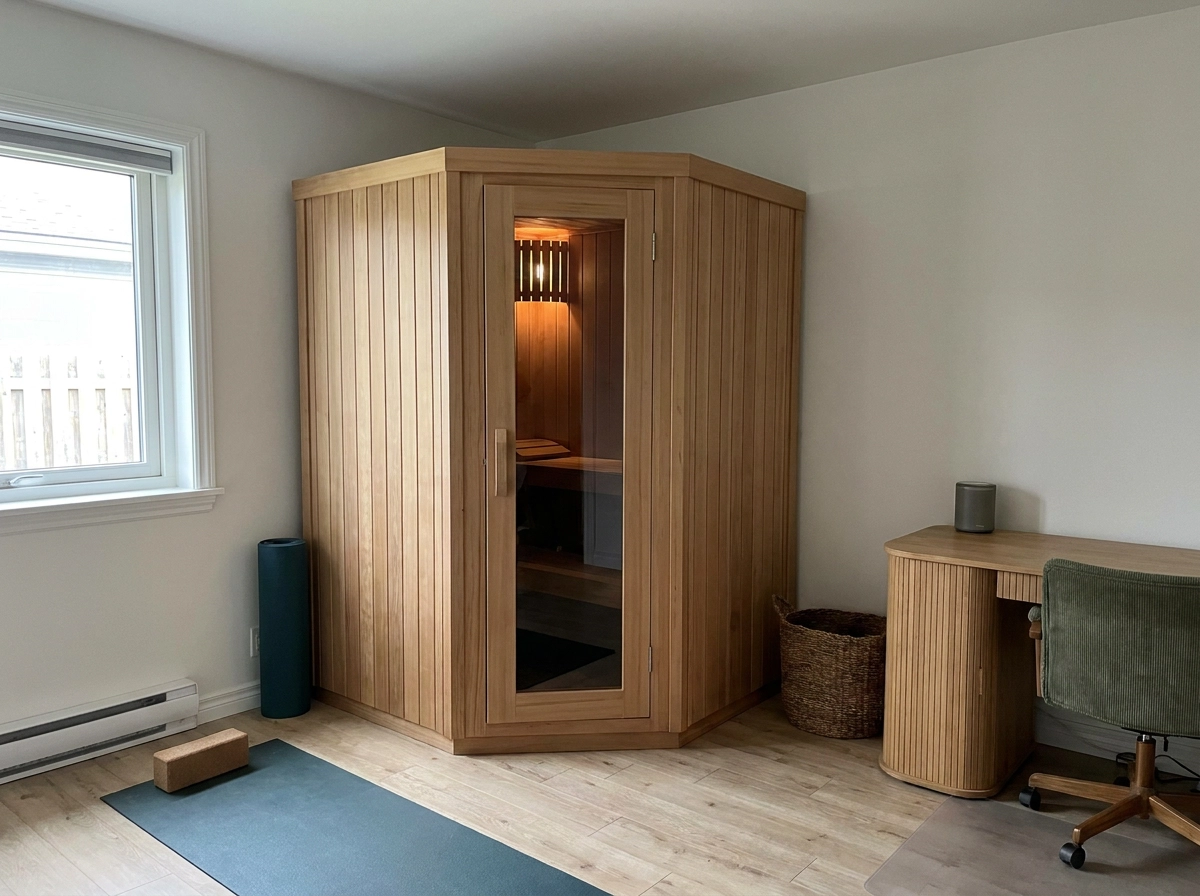
Space requirements follow a similar pattern. A compact two-person infrared cabin can fit in a bedroom corner or basement nook, making a spare bedroom, basement, or home gym wall a realistic location. A traditional sauna room for comparable capacity requires a larger dedicated footprint, along with additional clearance for construction access and ventilation placement.
Outdoor traditional saunas shift some of these constraints. Moving the unit outside eliminates indoor moisture management concerns, but introduces weatherproofing requirements and a longer electrical run from your panel, both of which carry their own costs.
The timeline difference is significant. Many infrared sauna owners complete assembly and take their first session on the same day. A traditional sauna room build, including framing, finishing, and electrical work, typically takes several weeks from start to first use.
Before purchasing either type, schedule an electrical panel assessment. Older homes with limited capacity may require a panel upgrade, and that cost belongs in your total budget calculation from the beginning, not as a surprise after delivery.
What Does a Home Sauna Actually Cost?
Once you’ve sorted out your installation plan, the next practical question is straightforward: what will this actually cost?
Infrared home sauna units for one to two people start at a more accessible price point than traditional builds. Mid-tier and premium models climb significantly higher, reflecting upgrades in wood quality, panel technology, and features like chromotherapy lighting or integrated audio systems.
Traditional sauna kits for indoor rooms represent a higher baseline investment before labor. Add professional installation, electrical work, and room finishing, and total installed costs commonly run $5,000 to $10,000 or higher, depending on the scope of the build.
Running costs differ significantly. Infrared saunas draw significantly less energy per session than traditional electric saunas, and for frequent users that difference compounds meaningfully over time.
Ongoing maintenance favors infrared. With no humidity management, no stones, and fewer mechanical components, upkeep is limited to periodic wood treatment and annual panel inspection. Traditional saunas require regular heater and stone maintenance, ventilation upkeep, and moisture management to prevent long-term wood damage.
A complete cost-of-ownership picture includes the unit price, installation, any electrical panel upgrades, projected annual energy cost, and periodic maintenance. Buyers who plan only for the sticker price routinely underestimate the real investment often significantly.
A household using a sauna three or more times per week will extract full value from a premium unit; occasional users rarely do, and that honest self-assessment should drive the budget decision more than any single line-item cost.
Lifestyle Fit: The Factor That Predicts Actual Use

Budget tells you what you can spend. Lifestyle fit tells you what you’ll actually use.
Solo or social? Infrared saunas are purpose-built for the solo wellness ritual. A short heat-up means you’re sweating within the first half hour, no planning required. Traditional saunas create a genuinely different atmosphere: the ritual of heating the stones, the communal bench space, the steam from a ladle of water. For households where two or more people want to sauna together regularly, that event-like quality adds real value.
Seasonal patterns matter more than most buyers anticipate. Traditional saunas hit their stride in winter, when high heat and steam become a warming ritual that’s hard to match. Infrared saunas perform consistently across all seasons because their lower ambient temperatures, typically 110 to 135 degrees Fahrenheit, stay comfortable even when your home is already warm in summer.
Schedule fit is the most underestimated factor. A complete infrared session, including heat-up, runs roughly 30 minutes total, making it realistic on a weekday evening after work or a workout. Traditional saunas demand more time: longer pre-heat, multiple rounds, and extended cool-down protocols. They reward households with flexible schedules or a weekend wellness mindset, not tight Tuesday evenings.
Household adoption drives long-term value. A sauna used by two or three family members three times a week justifies its footprint far better than one claimed by a single user on weekends. Before choosing a type, ask honestly which format each person in your household would actually gravitate toward.
The single most clarifying question in this entire decision: When, specifically, during a typical week would you use it, and for how long? Your honest answer points directly to the right choice.
Maintenance and Long-Term Ownership
Lifestyle fit determines which sauna you’ll actually use. Long-term ownership costs determine whether the investment holds its value.
Infrared saunas are genuinely low-maintenance. After each session, wipe down the interior surfaces. Treat the wood every few months with a dry wood conditioner to prevent cracking. Inspect the heating panels once a year. Because most infrared units have no plumbing, no drainage, and no humidity to manage, there is simply less to maintain.
Traditional saunas carry a more active upkeep routine. Clean the heater and rotate or replace the stones periodically, as mineral buildup and cracking reduce heat efficiency over time. Seal or oil the wood benches and walls regularly to protect against the repeated heat and steam cycles that stress the material. Keep the ventilation system clear to prevent moisture accumulation and mold, which are the primary long-term threats to a traditional sauna room.
Component lifespan differs meaningfully between the two types. Infrared panels vary by technology: ceramic and carbon systems are the most common residential options. Quality carbon panels are built to withstand many thousands of hours of normal use. Traditional electric heater elements typically last several years, with longevity tied directly to usage frequency and how often water is poured over the stones for steam.
Wood choice affects durability and cost in both sauna types. Cedar is naturally moisture-resistant and aromatic, making it a premium option. Hemlock is a more affordable, stable alternative with a clean, neutral character. Basswood is the lightest in color and the gentlest on sensitive skin, though it requires more attentive care over time.
Resale value plays out differently depending on type. A professionally installed, well-maintained traditional sauna room can enhance a home’s perceived value at resale. A freestanding infrared unit is a portable asset; if you move, it moves with you.
Building a Complete Home Wellness Space
Long-term ownership value increases significantly when your sauna doesn’t exist in isolation. Research on contrast therapy confirms that alternating heat with cold water immersion improves short-term recovery, reduces muscle soreness, and supports cardiovascular function, making the combination of a home sauna and a hot tub or swim spa genuinely more effective than either alone.
The pairing that makes sense depends on where your sauna lives. An infrared unit’s compact footprint and minimal ventilation requirements make it a natural anchor for an indoor wellness room, placed alongside a cold plunge tub, a yoga mat, or a dedicated meditation corner. A traditional outdoor sauna, by contrast, pairs seamlessly with a backyard hot tub or swim spa, creating a year-round retreat that draws family and guests as naturally as any other outdoor living space.
Placement context also predicts usage. Homeowners who integrate a sauna into a purposefully designed wellness environment, rather than tucking a standalone unit into an underused basement corner, are more likely to use it consistently. The surrounding space signals intention and reduces friction, which matters far more over a five-year ownership window than any single equipment feature.
Planning the full environment before finalizing your sauna choice also sharpens placement decisions. Knowing that you want contrast therapy access, for example, changes both the sauna type you choose and where you position it relative to your water feature.
Premium Spas & Billiards carries both infrared and traditional sauna options alongside hot tubs, swim spas, and game room products, which makes it a practical single destination when you are designing a space rather than just purchasing a unit. Working with one source across multiple product categories simplifies coordination on dimensions, electrical planning, and delivery timelines, all of which affect how smoothly the finished space comes together.
Infrared vs. Traditional Sauna: Side-by-Side Quick Reference
With all the key differences covered across heat experience, installation, and lifestyle fit, here is everything distilled into a single scannable reference.
| Category | Infrared Sauna | Traditional Sauna |
|---|---|---|
| Heat mechanism | Light-based radiant panels warm the body directly | Stove and stones heat the surrounding air; optional steam from water poured over stones |
| Operating temperature | 110 to 135°F | 160 to 200°F |
| Session duration | 25 to 40 minutes continuously | 10 to 20 minutes per round, with cooling breaks between rounds |
| Heat-up time | Shorter heat-up (typically under 20 minutes) | Longer heat-up (typically 30 minutes or more) |
| Installation | DIY-friendly; standard 120V or 240V outlet, no special ventilation required | Professional installation typical; dedicated 240V circuit, ventilation, and moisture-resistant materials required |
| Energy use per session | Lower draw per session | Higher draw per session |
| Best fit for | Solo daily wellness routines, heat-sensitive users, compact indoor spaces | Classic high-heat experience, social or family use, outdoor installations |
| Maintenance | Low; wipe-down after use, occasional wood treatment, no humidity management | Ongoing; heater and stone cleaning, wood sealing, ventilation upkeep to prevent moisture damage |
No single row determines the right choice on its own. The most useful way to read this table is column by column against your actual situation. If your priority is a quick weeknight recovery session in a spare bedroom, the infrared column aligns at nearly every row. If you are planning a backyard installation where weekend gatherings are part of the appeal, the traditional column reflects that use case just as consistently. Let the pattern across all eight categories point you toward the fit, not any one specification in isolation.
How to Choose the Right Sauna for Your Home
The specs above give you a clear framework. Now the decision comes down to five practical questions only you can answer.
Start with your primary wellness goal. If daily stress relief, muscle recovery, or post-workout decompression drives your interest, infrared aligns with those goals naturally. If you want the full heat ritual experience, steam, and the kind of session you share with family or guests on a winter weekend, traditional delivers something infrared simply does not replicate.
Assess your installation reality before you browse models. As covered in the installation section, your available space and electrical capacity will eliminate many options before price enters the conversation.
Match session format to your actual weekly schedule. Be honest here. If your realistic window is 30 to 45 minutes on a weekday evening, an infrared home sauna fits that pattern cleanly. If your household gravitates toward longer, unhurried wellness sessions on weekends, traditional may reward that style of use more fully.
Build a true total budget. As outlined in the cost section, the full number including installation, electrical upgrades, and ongoing energy use is what you are actually committing to, and it often shifts the comparison meaningfully.
Visit a showroom if you can. Reading about the difference between infrared radiant warmth and the enveloping heat of a traditional sauna only goes so far. Most people who sit in both back-to-back reach a clear personal preference within minutes. That firsthand experience is worth more than any specification chart.
Finally, think about the broader wellness space you are building. The best sauna for home use is not the one with the most features; it is the one that fits seamlessly into the environment and routine you are genuinely committed to creating.
Find the Sauna That Fits the Life You Actually Live
Once you’ve worked through the criteria in this guide, the decision often becomes straightforward. Both infrared and traditional saunas deliver genuine, well-documented wellness benefits. The deciding factor is almost never which type is objectively superior; it’s which one fits the home you live in, the schedule you actually keep, and the wellness goals you’ll still be pursuing two years from now.
Lifestyle fit outweighs technical specifications at every stage of this decision. A sauna with impressive heat stats that you use twice and abandon costs far more than a modest unit that becomes a weekly ritual. Factor in the full cost of ownership, including installation, electrical work, and ongoing energy use, and think beyond the unit itself to the broader wellness space it will anchor, because a sauna integrated into a purposefully designed environment gets used consistently in a way that an afterthought placement rarely does.
At Premium Spas and Billiards, we carry both infrared and traditional sauna options alongside hot tubs, swim spas, and a full range of home entertainment products. Our team can walk through your specific space, budget, and health goals with you, helping you move from comparison to confident decision without the guesswork.
The best sauna investment is the one you return to, consistently, season after season. Make the choice based on the life you actually live, and it will deliver for years to come.
Conclusion
When you are ready to move from research to a real decision, the team at Premium Spas and Billiards is here to help. We will match you with the right sauna for your home, your health goals, and your life as it actually looks. Visit us today and take the first step toward a wellness space you will return to for years to come.